
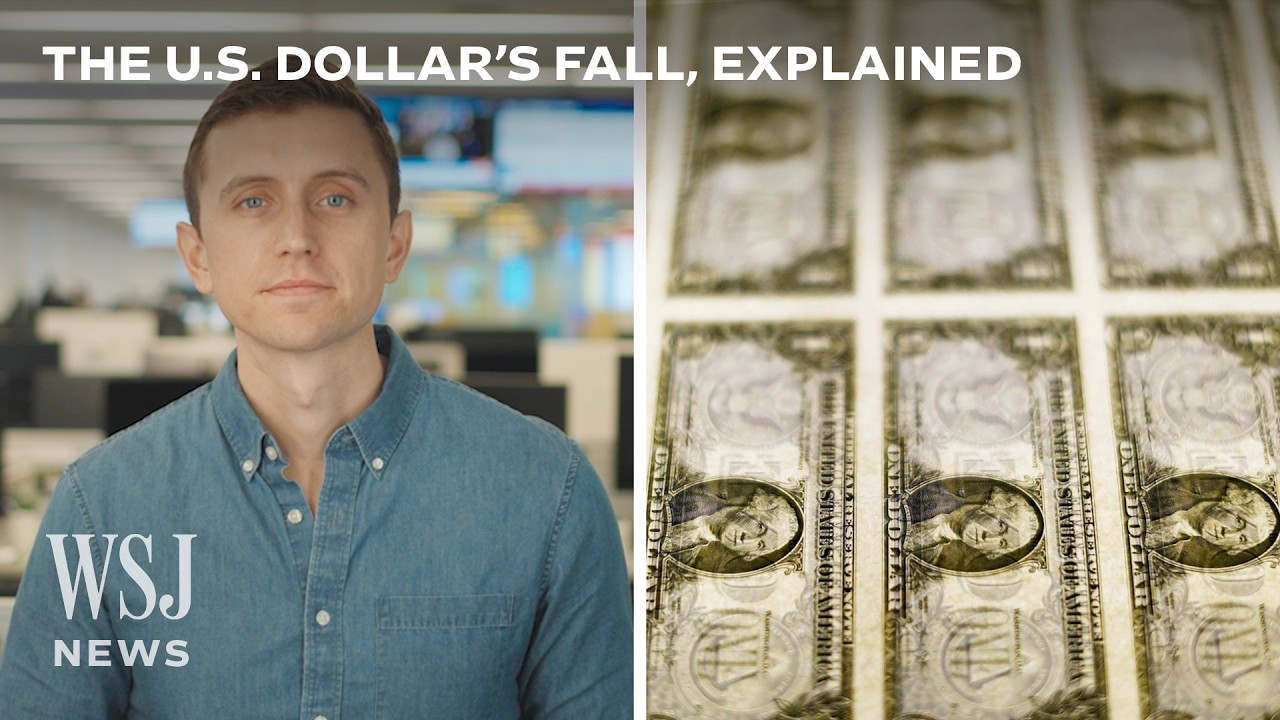
WSJ’s David Uberti explains why the U.S. dollar has been been decreasing in value recently and how a weaker dollar could boost President Trump’s economic agenda. Photo: Gary Cameron/Reuters
#Dollar #Trump #WSJ
source
Disclaimer: The information provided on this website is for educational and informational purposes only and should not be considered financial, investment, or legal advice. Stock markets, real estate, and other financial instruments involve significant risks, and past performance does not guarantee future results. You should conduct your own research and/or seek advice from a licensed financial advisor before making any investment decisions. The website owner is not liable for any financial losses or damages arising from the use of the information presented here.
About The Author




Buy Trump coin 🤣
Dolla 👀
All the stuff you buy at Walmart or on Amazon will keep getting more expensive. And don’t forget the tariffs!
Inflation at 8.5% now, get ready for 20% Inflation coming soon, banks are failing
Well…America elected Trump
Trump said MAGA…The American sheep sucked up his words.
So he went about screwing over, trying to screw over, Canada and other allies and trading partners..
He threatened Greenland/Denmark with military invasion.
Y'all cheered him him on…
Tell me… Who is paying the Tariffs?
When your ready America, fix your Trump problem
The USA 🇺🇸 leads in Engineered Intelligence yet it fails to use those systems to create policy. Instead, you have casino strategies coupled to strategic ambiguity and ego.
The fallout: a market crash greater than the GFC.
We elected a criminal who is mentally deranged. Moreover, he is an economic incompetent. His arbitrary actions have alienated our allies and endangered our own citizens. Recall the old observation: "How did you go bankrupt? Slowly….then all of a sudden."
So much 'winning' we've BEEN sick of it already. Trump is such a complete debacle.
But doesn't trump want to get rid of the fed chair??? He wants us to bottom out.
Deficit sounds bad but is there any really problem with a trade deficit? Like i have a trade deficit with my corner store, i buy way more stuff from them than they buy from me because i can afford to… we can buy more stuff because we can afford to, or at least we used to…
Wait um did you say the treasury dept did things to strengthen the yen… perhaps we need a video on that because… WHAT!?
American planes and cars aren’t competitive on the world market because the cars are ridiculously big and inefficient and the planes fall out of the sky. Most US made goods have the same problem, they are built down to a price so that they maximise shareholder profits, this makes them poorly made junk to the rest of the world.
could use stronger currencies around world for affordable prices that also increases trade by making exports more affordable lowering trade deficits; reduce debt by cutting and paying for spending, use some of monetary and fiscal stimulus to purchase government bonds of other nations to help with government spending and reduce debt as well as stronger currencies, allow higher interest rates discourages government overspending
What may be a problem in the near future is that the loss of confidence in the American financial system, may cause countries to not buy OUR debt or even worse is that they dump OUR debt. They may invest in gold or crypto currency. Then what will happen to the value of the dollar? Inflation skyrocketing? It is going to get interesting! 🇺🇸✌️👁️🇺🇸
😂 Happy liberation day 😂😂😂😂😂 April 1st 😂😂😂😂😂😂😂 Donald Day 😂
As an expat in Asia, I have noticed a steady decline in my buying power beginning in 2025
Turncoat is doing his con well, fooled all the voters…
He didn't mention one of the most significant factors: The lawless wars and kidnapping. That will only increase the already high US debt to GDP. Military spending unsustainable and is not going to keep the US empire as a hegemon; a fruitless exercise that future generations of Americans will burden the cost of. Trump and hid intellectually challenged neocons don't care – they never have picked up a decent history book, and in the case of Trump not any book
High debt to GDP caused the loss to Britain of its empire, as a result of its questionable intervention against Germany. Go back to the decline of any empire, and the root cause is its punching above its weight in warfare as the US is, believing it is more powerful than it actually is and turning a blind eye to its mounting debt. The US has never defeated any major force on its own, and never will. High time someone sat down the politicians and school them as such.
The US economy is "growing at a healthy clip"…? I don't think that statement there at the end will age well.
It hasn't plunged it's being destroyed by Donald J Trump
Just the start, wait till the vast majority of the world drop $US , look how much gold has been bought.
We have built a financial deity that is not worthy of our servitude, yet cannot live without. It is a sovereignty without conscience, a deity that demands sacrifice but offers no redemption. Modern finance is not a technical discipline, but a branch of political science and social psychology. The "full faith and credit of the United States" is not just an accounting term. It is a live, fragile, and recursive political covenant between:
· The government and its creditors,
· The government and its citizens,
· And the citizens amongst themselves.
The people are the initial source of the system's strength. (their labor, innovation, and trust) They become the ultimate source of its peril when that trust is violated or politicized. The system's greatest strength—its foundation in democratic sovereignty—is also its greatest vulnerability. In any society—including the Roman Empire, a modern state, or a religious community—sanctions are the system's mechanism for self-perpetuation and boundary enforcement. They are "Caesar's tools," used to maintain Caesar's order, far from rendering to God what is God's. Bearing it becomes a witness. You are "rendering to Caesar" his punishment (you accept the temporal consequence), while still "rendering to God" your unbroken spirit and truth. This is the martyr’s or dissident’s path. The sanction, meant to break you, instead reveals the system's injustice and your higher allegiance. Our best judgments—and punishments—are always partly Caesar’s. And that is the weight of the cross. Idolatry – Serving a created thing (an idol, money, a nation) as if it were the ultimate source of good. The thing itself becomes the point, draining life rather than giving it.
Tyranny – Serving a ruler or system whose sole purpose is its own power and glory. The subject's well-being is irrelevant except as fuel for the regime.
Meaningless Hierarchy – Serving a position or structure that exists only to validate its own authority, creating no value, only compliance. Self-Perpetuation as the Primary Goal: When the stability of the dollar system itself becomes the paramount objective, overriding other values like equity, justice, or national sovereignty. Policies are made to protect the dollar's status, not necessarily to enhance global welfare. Extraction Over Contribution: When the privileges of the system (seigniorage, lower borrowing costs for the U.S., sanctions power) are used primarily for the benefit of the issuing nation at the expense of others, it becomes a mechanism of extraction—a form of financial tribute. Coercive Compliance: When the threat of exclusion ("you will be banished from the financial kingdom") is the primary tool for enforcing rules that serve the hegemon's political interests, not shared principles. This is the tyranny mode.
Which countries that he has been bad-mouthing will be buying the cheaper American products ? None. Those that don't now won't, and others will join them.
BUY YUANS…. it's the future….
I am a liberal but WSJ financial reporting is good with a balanced view. Yes, a weaker dollar makes our exports cheaper to foreign consumers but it makes imports more expensive to American consumers. Many goods are not manufactured in America and we will pay more for them. And, many goods made here in America use imported parts and these "made in America" goods will also cost more for American consumers. I think a better plan would have been to give American companies tax incentives to build here in America and to continue with the infrastructure projects passed under Biden. At the moment, AI productivity gains and building AI power and computer infrastructure is pushing the American economy. Long term, a weak dollar isn't good for our economy in our view. Trump is basically trying to make imports so expensive that we can afford to build the goods here. The problem is prices for goods will likely have to double or triple to make that dream come true. Don't believe me? A foreign made smart phone is about $1,000 while to manufacturer that same phone in America is estimated to cost $3,500. Look at sporting goods or musical instruments and you'll also see American goods cost 2 to 3 times as much as imports. Tariffs and a weak dollar will make Americans poor again.
You do not make anything of value.
You do not export anything of value.
Made in the USA is an immediate and total reason not to buy.
I absolutely see the market for US made quad cab dually wheel pickup trucks exploding in Denmark, Belgium, the Netherlands, Italy, Estonia, Portugal, Japan……
MAGA where is the ‘Great” part? Let me guess 2 more weeks? Biden did it? The left did it? How about the stupid freakin president has screwed all this up!
2 trillion in one year😂
Someone did a food chopper job on the WSJ with tabloid visuals, NYT slants, and old style factual explanation bringing up the rear. It's sad.